Three selected artists and a network of proposals. The first Spanish edition of Culture & Health for artists in healthcare settings, launched in Spain by Cultura en Vena, reveals the vitality of the Arts and Health sector in our country.
Within the framework of the European programme CultureAndHealth Platform (2024–2028), the National Open Call for Artists in Healthcare Settings aims to support artists and collectives developing cultural projects with an impact on the physical, mental, emotional, or social health and well-being of individuals and communities, in collaboration with healthcare institutions.
Following its first launch in January 2026, Cultura en Vena seeks not only to share the selected projects, but also to reflect on the quantity and quality of the proposals received.
PARTICIPATION
The call received 214 proposals from across Spain. This response—remarkable for a first edition—confirms the growing interest in the intersection of culture, health, and care. While the number is striking, the quality is even more so: the submitted projects stand out for their artistic strength, their sensitivity to contexts of vulnerability, their attention to diverse beneficiary groups, and their ability to imagine new ways of accompaniment, listening, and well-being through cultural practice.
REGIONS
Beyond the outcome of the selection process, Culture & Health Spain reveals an important reality: a genuine Arts and Health ecosystem already exists in Spain. The call has not only enabled the selection of three particularly strong proposals, but has also provided a first snapshot of an emerging sector that was already developing and is now becoming more visible.
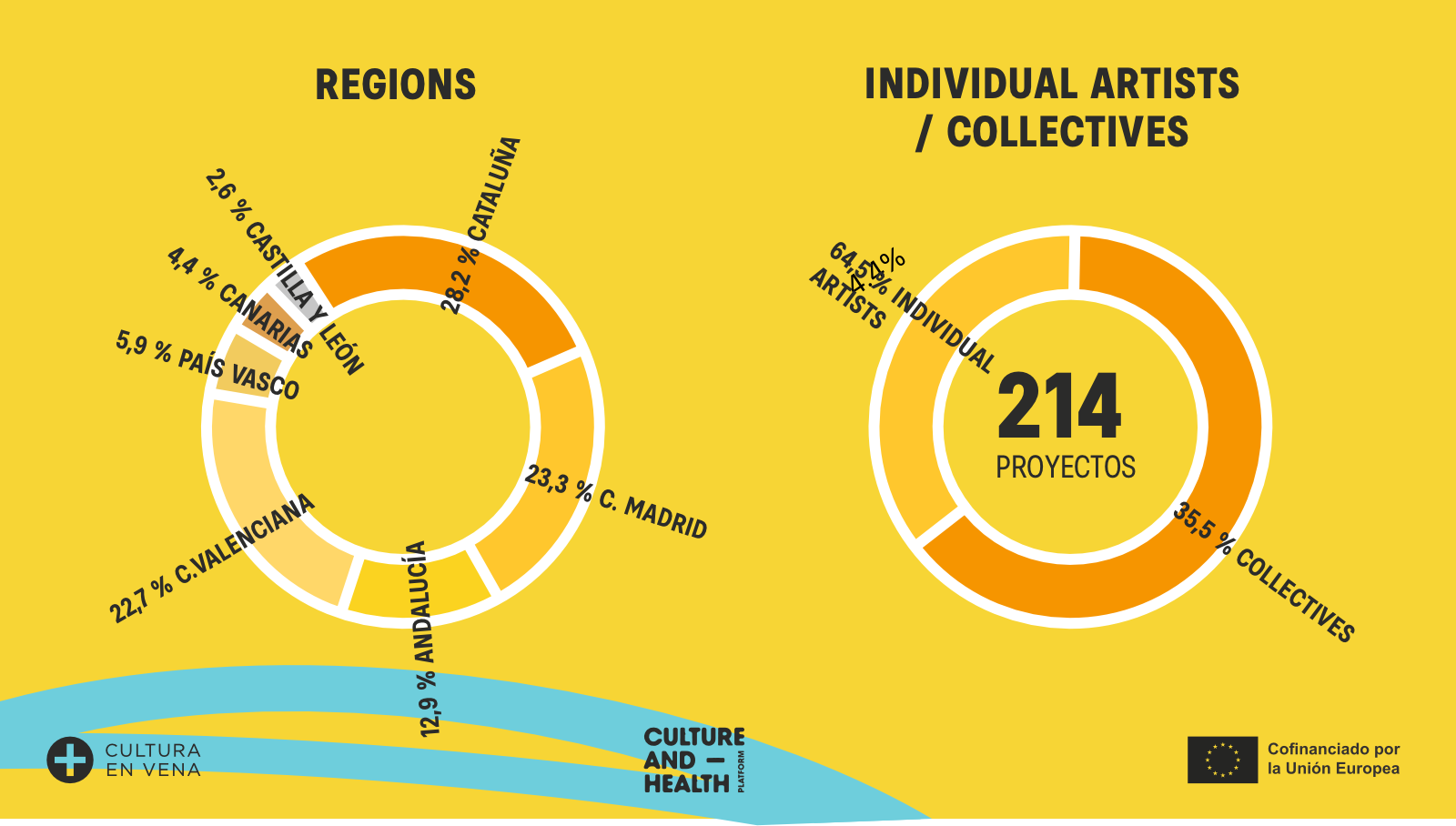
The applications reflect a broad territorial distribution, with a strong presence from Catalonia (63 applications; 29.9%) and the Community of Madrid (52; 24.6%), followed by Andalusia (29; 13.7%) and the Valencian Community (21; 10.0%).
INDIVIDUAL ARTISTS / COLLECTIVES
The profile of participants also points to a sector with its own structure. Most applications were submitted by individual artists (64.5%), although the presence of collectives (35.5%) highlights the importance of collaborative practices, shared methodologies, and established working structures. There are strong individual trajectories, but also a collective force that signals the consolidation of this field.
ARTISTIC DISCIPLINES
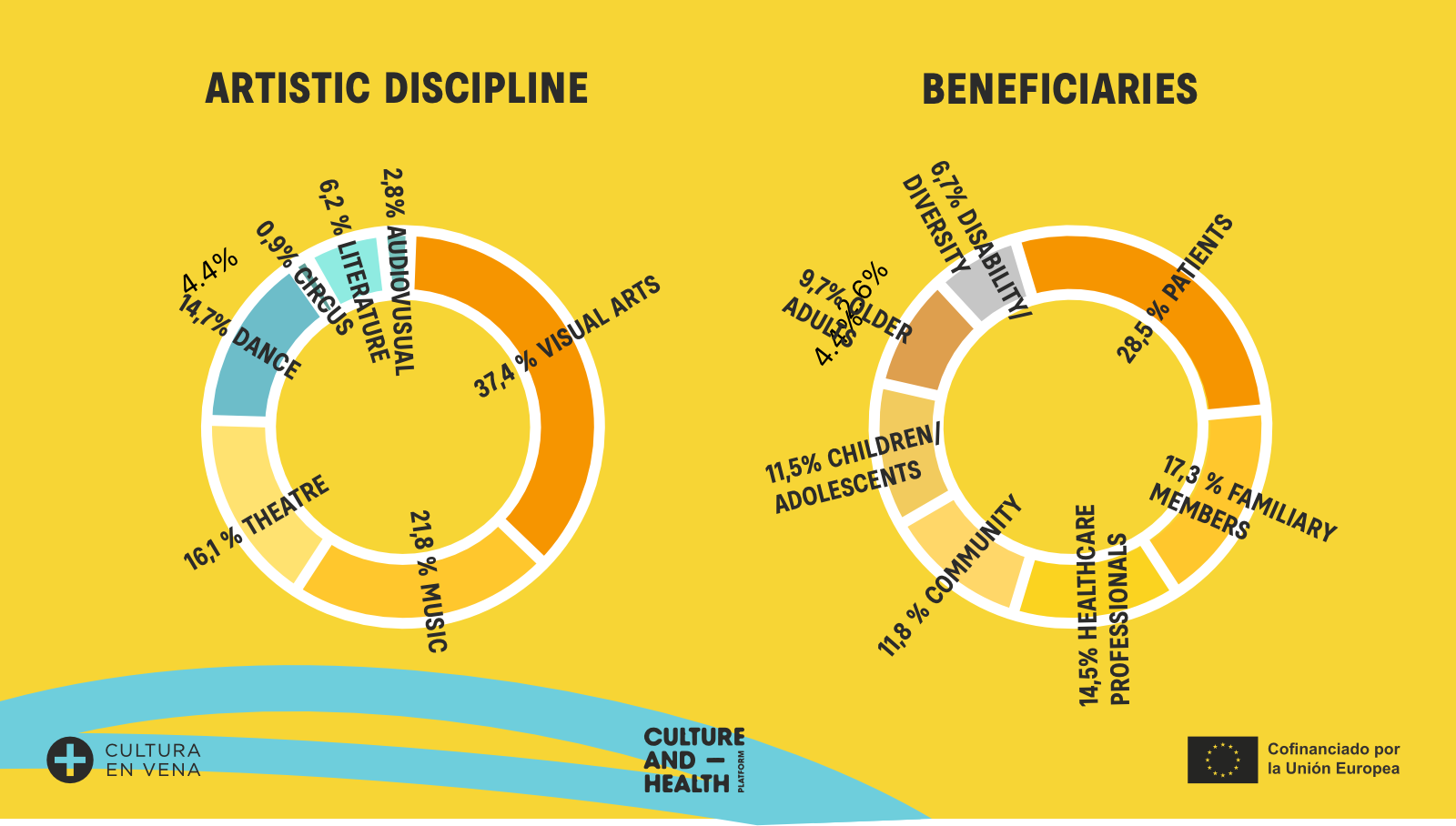
The proposals span a wide range of artistic languages. Performing arts (music, dance, theatre, circus) lead the field with 53.5%, followed by visual arts (37.4%), literature (6.2%), and audiovisual arts (2.8%). However, perhaps the most significant insight lies not only in which discipline leads, but in the prominence of hybridity: 103 projects—nearly half of the total—are interdisciplinary, confirming that when culture and health meet, artistic languages blend and expand.
BENEFICIARIES
The call also shows that the arts are being directed where they can have the greatest impact. Projects primarily target hospitalised patients (44.5%), family members and caregivers (27.0%), and healthcare professionals (22.7%). This range of beneficiaries reflects a broad understanding of care: one that extends beyond the patient to include those who accompany, support, and work daily within care environments.
Similarly, the benefits most frequently identified in the applications clearly highlight the key contributions of the arts in this field. Emotional well-being and social cohesion or connection predominate, followed by cognitive stimulation, physical well-being, and the humanisation of healthcare environments. In other words, these proposals are not only about cultural activity—they speak of relief, connection, presence, participation, and the enhancement of care experiences.
SELECTED PROJECTS
Following the evaluation process, the selection committee has chosen three proposals that stand out for their artistic quality, their ability to adapt to healthcare contexts, and their participatory approach in working with patients, professionals, and communities connected to health.
The selected projects in this first edition are:
— “La Quinta Escena”, a performing arts and mental health project at the Psychiatry and Mental Health Clinical Management Unit of the Hospital Universitario Príncipe de Asturias (Alcalá de Henares, Madrid), by Inés Gasset Martín-Laborda.
— “Mirar(se) con otros ojos: Crear y cuidar” (Seeing Ourselves Through Other Eyes: Creating and Caring), a participatory visual narratives project for biomedical humanisation at Hospital Universitario Vall d’Hebron (Barcelona), by ArtVitae (Gina Mas Assens and Almudena Martín).
— “Mujeres que Transforman la Salud Mental” (Women Transforming Mental Health), a ceramic craft project for women with Severe Mental Disorders within the Mental Health Network of Bizkaia (Basque Health Service), by Evelyn Pelayo.
Over the coming months, the selected artists will develop their projects in collaboration with healthcare institutions, in a process that combines artistic research, situated work with the communities involved, and the exploration of new methodologies at the intersection of Arts and Health.
With this first edition—aligned with the principles of the Creative Health Quality Framework—Cultura en Vena is not only launching a line of support for artistic creation, but also helping to name, connect, and strengthen an emerging field that already exists and calls for greater space, stronger alliances, and increased institutional recognition.
Because this call does more than select projects: it makes visible a real and growing force at the intersection of culture, health, and care.
